
Case studies / Finland
Case study: Finland
Summary
This is a summary description of the coarse grain analysis of the Finnish Case study, and a brief description of the further research questions for the fine grain case study. Eeva Primmer, SYKE
Case study location and
conservation characteristics
Current economic
instruments in biodiversity conservation
 Currently, the formal Finnish forest
biodiversity conservation instruments include regulatory instruments and
economic instruments as well as information and extension services. The traditional
national parks, strict nature reserves and nature conservation programme areas
(including the European Union Natura 2000) are supplemented with Forest Act
habitats and Forested Nature Conservation Act habitats. Private protected areas
are currently established dominantly through positive economic incentives under
the METSO Programme attracting voluntary offers from forest owners, in a PES
fashion. This protected area contracting is the responsibility of the
environmental administration. Under the METSO Programme, PES contracts are also
made for a fixed term by the forestry administration, under the Act for
Financing Sustainable Forestry. The two PES-like mechanisms merge the ideas and
practices of the PES contracts piloted jointly by the environmental and forestry
administration in 2002-2007 and the pre-existing environmental subsidy that
compensates for timber income loss.
New and potential economic
instruments
To
scope for new potential conservation instruments, the Finnish case study has
ran a focus group workshop with the Advisory Board members, representing
environmental and forestry administration, land-use planning, forest owners and
environmental NGOs of national level and local level. The already upcoming new
instruments or changes in existing instruments identified in the focus group
included broadening law-based habitat conservation to cover more habitat types,
or providing significantly more subsidies or incentives for nature management
and restoration of altered habitats or diversifying forest management and
silviculture with uneven-aged forest management. More radical new instruments
identified by the focus group include strengthening
nature conservation by developing a biodiversity law, allocating more nature
conservation power and budgetary resources to environmental administration, or backing
up the environmental administration with more forest nature management
competencies to allow forest administration to focus mostly on forestry.
Also developing economic instruments by increasing incentives significantly and
paying for existing or increased nature values or developing land-use planning
would be more radical developments.
Instrument interactions in
the national policymix
The
different policy instruments in the current mix supplement each other in
potentially attracting different types of forest-owners; more preservation
oriented owners will choose a permanent private protected area and more
forestry income oriented ones will choose the fixed-term METSO-PES. According
to the Case Study Advisory Board members, fixed-term contracts have functioned
as a gateway for forest-owners to enter a conservation contract, attracting
them to consider also permanent conservation. This proposition will be examined
further in the fine grain analyses. It is also possible that conservation
programmes preceding the METSO era provide motivation for taking up less
restrictive instruments. This potential 'regulatory assurance', where the
existence of a regulatory instrument is crucial for the success of a voluntary
instrument, will be further studied.
The
sequence of the policy instruments has clearly played an important role in the
evolution of the Finnish METSO PES. Without the criticism against the
conservation programmes and the implementation of the Natura 2000 network, the
METSO incentives would not have been developed. Similarly, the success of the
PES has largely relied on the new opportunities and new practices brought by
the voluntary scheme implemented in collaboration between the environmental and
forestry administrations, although the piloted joint administration has
discontinued. As our analysis of the institutional evolution demonstrates, the
current application of the METSO-PES has reverted back to many institutional
features that existed prior to the METSO pilot. Further analysis will
rigorously test the prevalence of the different institutional factors that
influence contract uptake currently and also examine how different institutional
arrangements characterize the potential outcomes of future policy-mixes.
Local fine grain
analysis – research questions and challenges
Fine grain case study site
description
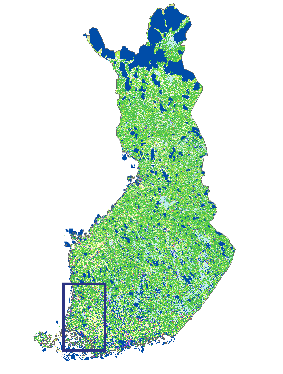
 South-Western
Finland is densely populated and has a diverse economy for the generally very
rural Finland. The area has 1 million hectares forest land, out of which
private people own 80%. These 37 000 non-industrial private forest holdings are
generally small in size, averaging at 21 hectares. Compared to the rest of the
country, forest owners in the area have acquired ownership actively and only a
third has inherited the land. Typical of southern Finland, the forests in the
area are fertile, productive and intensively managed. The same forests are used
for recreation, berry and mushroom picking and hunting.
The area has low conservation coverage, with 2,5 percent of the forest area strictly protected and 0,4 percent of private forests designated as Forest Act habitats. The South-Western Finland Forestry Centre region piloted the METSO Programme during 2003-2007. Actually, the so-called ‘nature values trading’ PES instrument idea originates in the area. As the forest owners in the area are have been exposed to the voluntary policy instruments for a ten-year period already and the administration has been engaged in developing these instruments, South-Western Finland makes an ideal case study area.
Economic instrument effectiveness
The ecological outcome of voluntary conservation
payments and of instrument mixes should be evaluated against the conservation
challenges that include low coverage and connectivity of protected areas. The
case study will layer the METSO PES forest holdings on a general Zonation
output to evaluate the conservation effectiveness in the fine grain analysis.
Additionally, to allow scenario analysis, the structure and the
quality of the forests that were included in the METSO PES holdings will be
examined with spatial analysis of forest inventory data. The structure and the
quality of the forests will be assessed with forest site types, dominant tree
species, development classes, age classes, volume of the growing stock and
increment of growing stock. These spatial analyses will be combined with
spatially referenced views of forest owners regarding the ecosystem services
that their forests provide from the survey responses.
Economic instrument costs and benefits
For understanding the costs and
benefits of conservation instruments, it is essential to understand the
difference that the PES contract or instrument mix makes as compared to no
conservation effort. Generally, opportunity costs are an important starting
point when analysing the conservation of previously commercially managed
forests. In addition to the opportunity costs, also the forest-owner views on
what rights they give up generate an important cost factor. As regards the
benefits, it is essential to acknowledge the ecosystem services that the forest
owners identify their contracted sites to provide, as they are well aware of
the functions of their forests and those who have already made a contract, have
first-hand experience with both benefits and costs. The Finnish local level
case study will evaluate the factors that have contributed to contracting and the
payment request of contracted and non-contracted forest owners, as well as
their perceptions of multiple benefits of conservation. The real contract fees
will be used to validate the payment request.
The Finnish fine grain analysis will
advance the understanding of contractual, institutional and social factors
contributing to the payment request. Similarly, the fine grain analysis will
allow measuring the value that the forest-owners place on the ecosystem
services they provide by contracting. As the contracts are voluntary, and they
are a genuine opportunity for any forest-owner who has an eligible site on
their land, the payment request reflects the ecosystem service value of the
service provider in a realistic fashion. Plotting the significant impacting
factors on a map, the fine-grain analysis will also explore the possibilities of
GIS analysis of timber-sale value (opportunity cost) on willingness to contract
and payment request levels. Similarly, transaction costs can be evaluated both
with the results of the survey (time invested in contracting and negotiation
time) and GIS analysis (distance to agency).
Economic instrument equity
and legitimacy
 Finnish forest-owners are relatively
wealthy and often rather independent from regular forestry income, and the
forest sector is rather powerful in steering timber production and also
influencing forest biodiversity policy. With the conflictuous history, the
administration seeks to treat forest-owners as equally and equitably as
possible. The private benefits of conservation and PES experienced by
forest-owners are often simplified to be expressed by income changes but they
can be much broader. Benefits experienced by forest owners include perceived
changes in benefit distribution, equal opportunity to contract and use multiple
ecosystem services, autonomy to decide about conservation and forest use,
justness of rights and responsibilities, security and predictability of the
policy and contract terms, and finally, biodiversity and ecosystem benefits.
The Finnish local level case study will address both distributive impacts and
legitimacy directly with the forest-owner survey.
The analysis will focus on perceived
benefits and their contribution to contracting. The Finnish case study will
contribute to the debate about fairness and equity in PES with experiences from
a wealthy empirical context. With the forest-owner views on ecosystem service
benefits and their relation to payment request, the survey will also allow
discussing the generally held views that values placed on ecosystem services
are of a public character and that their valuation should rely on contingent valuation
methods. The Finnish forest-owner survey will address the forest owners' use of
information, their trust and their shared interests relative to a range of
relevant actors implementing and intermediating the METSO PES.
Institutional
opportunities and constraints for economic instruments
Introducing PES instruments will
necessarily change forest owners’ rights and responsibilities. By doing this, the
PES re-determine also the rights and responsibilities of different
administrative and organizational actors. In addition to these formal
regulative institutions, changes occur in the normative institutions carried by
professional and standardized practices as well as cultural cognitive
institutions reflecting the perceived functions of forests, forest management
and biodiversity conservation. Although the PES contract terms and their acceptability
have been studied in Finland, and the role of the administration and
intermediaries is also well known, the forest-owners' views on their own rights
and responsibilities has not been analyzed together with their views of the
rights and responsibilities of other actors. The Finnish fine grain analysis
will close this knowledge gap.
Much of the Finnish local level case study focuses on
the rights and responsibilities and the impacts of their redistribution,
through forest-owner perceptions. In addition to analysing the influence of
institutions on the take up of a PES contract and the payment request, the
survey will allow in-depth analysis of the weight placed on the rights of
different actors, which can be analyzed against earlier work on legitimacy and institutions
of forest biodiversity governance. The results will enlighten the institutional options and
constraints of METSO PES and other instruments. This will be backed up by the focus group work for the multicriteria analysis of instrument mix scenarios.
Integrated policymix
assessments
Environmental decisions and policy
assessments are often complex, involve many different stakeholders and
typically draw on multidisciplinary knowledge bases, incorporating natural,
physical and social sciences, politics and ethics. To consider the multiple
impacts and constraints of different instruments applied jointly, the Finnish
case study will conduct a spatially referenced multi-criteria analysis (MCA) of
instrument-mix scenarios. This will not be a full blown spatial MCA, but the
method relies on combined use of geographic information systems (GIS), spatial
analyses and MCA.
 The GIS is used to
produce and handle the geo-referenced data needed for producing the alternative
conservation area configurations under the different instrument mix scenarios,
and as a platform to present and visualise the results of the analyses as
thematic maps. The MCA will draw from the fine-grain analysis of institutional,
social, ecological and economic perceptions of forest owners. The scenarios
will take the existing budget as a starting point and take the current
implementation of METSO PES as baseline scenario. Based on stakeholder focus group
work, the alternative scenarios will be built around the following new
instrument mixes 1) Voluntary permanent conservation; 2) Enforced spatially
concentrated permanent conservation, 3) Voluntary permanent conservation with
active nature management; 4) Voluntary temporary conservation. The ecological
indicators considered for this analysis include carbon sequestration, forest
age structure and its changes, the amount of fertile forest site types,
connectivity and the amount of coarse woody debris. The economic indicators
considered include opportunity costs (lost timber sales income), transaction
costs (negotiation time) and employment opportunities. The social indicators
considered include recreational opportunities, perceptions on who benefits and
distribution of benefits in society, perception of legitimacy and fairness of
the contracting process. The information for the indicators will be obtained
from the administration, the forest owner survey, forest resource information
and from the Streering Group of the Finnish case study. The Streering Group
will represent the decision maker in the MCA and state preferences for the
different criteria and indicators.
Abebe, S. et al. (2011) A review of the cost-effectiveness and performance of selected Verifiable Emission Reduction (VER) carbon offsets. Joint Technical Brief POLIYCMIX and FUNCiTREE No. 1
Project publications • Ecosystem service values
Andrade, J. et al., compensation for Legal Reserves in Northwest Mato Grosso: a policymix to reduce deforestation
Project publications • Modelling
Balvanera, P. et al.(2012). Ecosystem services research in Latin America: The state of the art . Ecosystem Services, In Press
Peer reviewed • Biodiversity and ecosystem impact;Ecosystem service values;Policy instruments - AEM
Barton et al. (2014) Guidelines for multi-scale policy mix assessments. POLICYMIX Technical Brief No. 12
Project publications • Institutional fit;Policy instruments - Comparisons & mixes
Barton, D. N. et al. (2010) Assessing the Role of Economic Instruments in a Policy Mix for Biodiversity Conservation and Ecosystem Services Provision: A Review of Some Methodological Challenges. Discussion Paper 1-2010
Project publications • Policy instruments - Comparisons & mixes
Barton, D. N. et al. (2012)Assessment of existing and proposed policy instruments for biodiversity conservation in Norway. Report 1/2012
Project publications • Policy instruments - Comparisons & mixes
Barton, D. N. et al. (2013) Guidelines for opportunity cost evaluation of conservation policy instruments. Technical Brief Issue no. 11 (rev.)
Project publications • Ecosystem service values
Barton, D.N. , I. Ring, G. Rusch (2014) Policyscape: Nature-based policy mixes for biodiversity conservation and ecosystem services provision
Project publications • Institutional fit;Policy instruments - Comparisons & mixes
Barton, D.N. et al. (2013) Policyscape—A Spatially Explicit Evaluation of Voluntary Conservation in a Policy Mix for Biodiversity Conservation in Norway. Society & Natural Resources: An International Journal, 26:10, 1185-1201
Peer reviewed • Biodiversity and ecosystem impact;Ecosystem service values;Modelling;Policy instruments - Protected area enforcement;Policy instruments - PES
Begossi, A., May, P. H., Lopes, P. F., Oliveira, L.E.C., Vinha, V. and Silvano, R.A.M. 2011. Compensation for environmental services from artisanal fisheries in SE Brazil: Policy and technical strategies. Ecological Economics, 71:25- 32.
Peer reviewed
Bernasconi, P.; S. Blumentrath; D.N. Barton; G. Rusch & A. R. Romeiro (2013) Policyscape— The potential of Tradable Development Rights (TDR) to improve effectiveness and reduce the costs of biodiversity conservation: study case in Sao Paulo, Brazil.
Project publications • Biodiversity and ecosystem impact;Ecosystem service values;Modelling
Bittner, S. and Lienhoop, N., 2013: Understanding non-participation of farmers in agri-environmental schemes for afforestation. The case of West Saxony.
Project publications • Ecosystem service values
Blumentrath, S. (2011) Site prioritisation models and their suitability for assessing and designing policy mixes for biodiversity conservation and ecosystem services provision: a comparison of software packages. Technical Brief Issue no.4
Project publications • Biodiversity and ecosystem impact;Modelling
Brouwer, R. and Simon, T. (2011) Review of the Biodiversity Valuation Literature and Meta-Analysis. Report 5/2011
Project publications • Ecosystem service values;Modelling
Brouwer, R. et al. (2013) Guidelines for biodiversity valuation and benefits assessment of economic instruments. Tecnical Brief Issue no. 10
Project publications • Ecosystem service values
Brouwer, R., Tesfaye, A., and Pauw, P. (2011). Meta-analysis of institutional-economic factors explaining the environmental performance of payments for watershed services. Environmental Conservation, 38(4), 380-392.
Peer reviewed • Ecosystem service values;Modelling
Bunikyte, R., G. M. Rusch, and B. J. Graae. 2012. A time-line analysis of the public biodiversity conservation mix: Changes in conservation gains in the county of Sør-Trøndelag.
Project publications • Biodiversity and ecosystem impact
Cassola, R.S. 2011. Ecological Fiscal Transfers for Biodiversity Conservation: Options for a federal-state arrangement in Brazil. Master thesis, Albert-Ludwigs-Universität Freiburg, Freiburg im Breisgau.
Project publications • Institutional fit;Modelling;Policy instruments - Ecological fiscal transfers
Chacón-Cascante et al. 2013. Evaluating the policymix path dependency of PES using socio-ecological system characteristics: the case of Hojancha, Nicoya and Nandayure
Project publications • Institutional fit;Policy instruments - PES
Chacón-Cascante et al. 2014. Social Impact evaluation of forest conservation and reforestation PES contracts in Hojancha
Project publications • Social impact;Policy instruments - PES
Chacón-Cascante, A.et al. (2012). Costa Rica: National level assessment of the role of economic instruments in the conservation policymix. Report 2/2012
Project publications • Policy instruments - Comparisons & mixes;Policy instruments - Protected area enforcement;Policy instruments - AEM
Clemente, P., Santos, R., Antunes, P., Pinto, R. Assessing farmers’ perceptions and performance of agri-environmental schemes in a multifunctional agro-forest system: lessons for instrument design in a conservation policymix.
Project publications • Biodiversity and ecosystem impact;Social impact;Policy instruments - Protected area enforcement;Policy instruments - AEM
Cárdenas et al. 2014. Costa Rica: Effectivity of PES carbon balance in livestock systems in Nicoya peninsula, Costa Rica
Project publications • Biodiversity and ecosystem impact;Policy instruments - PES
Dang Phan, T. et al. (2014) The economic costs of avoided deforestation in the developing world: A meta-analysis. Journal of Forest Economics 20 (2014) 1-16
Peer reviewed
Del Arco, P., May P. H., Rusch, G.. 2013. The effect of forest proximity on biological control of pasture in Northwest Mato Grosso, Brazil: an economic analysis for land use policy. ESEE Conference, Lille.
Project publications • Biodiversity and ecosystem impact
Droste, N. 2013. Naturschutz im föderalen System Deutschlands. Eine ökonomische Perspektive auf einen ökologischen Länderfinanzausgleich. Masterarbeit, Carl von Ossietzky Universität Oldenburg und Helmholtz-Zentrum für Umweltforschung - UFZ, Leipzig, Oldenburg.
Project publications • Institutional fit;Modelling;Policy instruments - Ecological fiscal transfers
Droste, N., Ring, I., Schröter-Schlaack, C., Lenk, T. Ecological Fiscal transfers in Germany. Discussion paper draft.
Project publications • Institutional fit
Fasiaben, M.C.R., Gori, A., Andrade, D.C., Ângelo, J.A. Costs of environmental protection in different types of agricultural production units: the case of Cantareira-Mantiqueira Corridor Region.
Project publications • Ecosystem service values;Policy instruments - PES
Grieg-Gran, M. et al. (2011) Guidelines for Assessing Social Impacts and Legitimacy in Conservation. Technical Guide Issue no. 1
Project publications • Social impact
Grieg‐Gran, M. et al. (2013) Best practice guidelines for assessing social impacts and legitimacy of conservation policy instruments. Technical Brief Issue no.8
Project publications • Social impact
J. Vivan (in memoriam), R. Davenport, P.C. Nunes, R. Abad, P.H. May, D.N. Barton, L.P. Amaral. 2013. Pilot projects and agroenvironmental measures in northwest Mato Grosso, Brazil: impacts and lesson for REDD+ policy “mixes.” Paper presented at ESEE Conference, Lille.
Project publications • Biodiversity and ecosystem impact
Kachele, K. et al. (2012) Forest certification: a voluntary instrument for environmental governance. In: Bandyopadhyay, J.; Chopra, K.; Ghosh, N. (eds.) Environmental governance: Approaches, imperatives and methods. Bloomsbury, Mumbai, p. 281-300, 2012.
Peer reviewed
Klassert, C., und Möckel, S. (2013). Improving the Policy Mix: The Scope for Market-Based Instruments in EU Biodiversity Policy. Environmental Policy and Governance (EPG) 23: 311-322
Peer reviewed • Policy instruments - Comparisons & mixes;Policy instruments - AEM;Policy instruments - Tradable rights & offsets
Lienhoop, N., Brouwer, R., 2014: Agrienvironmental policy valuation: Farmers‘ design preferences for afforestation schemes. Land Use Planning
Peer reviewed • Ecosystem service values
Lindhjem, H ., K. Grimsrud, S. Navrud and S. O. Kolle (forthcoming) "The Social Benefits and Costs of Preserving Forest Biodiversity and Ecosystem Services".
Peer reviewed
Lindhjem, H. and Mitani, Y. (2012) Forest owners’ willingness to accept compensation for voluntary conservation: A contingent valuation approach. Journal of Forest Economics 18 (2012) 290–302
Peer reviewed
May P. H., M. F. Gebara, G. Lima, C. Jordão, P. Nogueira, M. Grieg-Gran. 2013. The effectiveness and fairness of the “Ecological ICMS” as a fiscal transfer for biodiversition conservation. A tale of two municipalities in Mato Grosso, Brazil. Paper presented at ESEE Conference, Lille.
Project publications • Policy instruments - Ecological fiscal transfers
May, P. et al. (2012) Assessment of the role of economic and regulatory instruments in the conservation policymix for the Brazilian Amazon – a coarse grain study. Report 5/2012
Project publications • Policy instruments - Comparisons & mixes;Policy instruments - REDD PLUS;Policy instruments - Ecological fiscal transfers;Policy instruments - Protected area enforcement;Policy instruments - AEM;Policy instruments - Tradable rights & offsets
May, P.H. et al (2012) The "Ecological" Value Added Tax (ICMS-Ecologico) in Brazil and its effectiveness in State biodiversity conservation: a comparative analysis
Project publications • Institutional fit;Policy instruments - Ecological fiscal transfers
May, P.H. et al (2013) The effectiveness and fairness of the "Ecological ICMS" as a fiscal transfer for biodiversity conservation. A tale of two municipalities in Mato Grosso, Brazil.
Project publications • Social impact;Policy instruments - Ecological fiscal transfers
Mitani, Y. and H. Lindhjem (2014) "Forest owners' participation in voluntary biodiversity conservation in Norway: What does it take to forego forestry for eternity?"... Resubmitted and under review, Revised April 2014.
Peer reviewed
Möckel, S. 2013 Zeitschrift für Europäisches Umwelt- und Planungsrecht 2013 (11), p. 85 - 94
Peer reviewed • Institutional fit
Paloniemi, Riikka and Vainio, Annukka (2011) 'Legitimacy and empowerment: combining two conceptual approaches for explaining forest owners' willingness to cooperate in nature conservation', Journal of Integrative Environmental Sciences, 8: 2, 123 - 138
Peer reviewed • Social impact;Policy instruments - AEM
Pinto, R., Antunes, P., Santos, R., Blumentrath, S., Clemente, P. Evaluating spatial targeting and planning effectiveness of policies: Illustrative example of an agri-environmental measure application in a multifunctional system. (in preparation)
Project publications • Biodiversity and ecosystem impact;Ecosystem service values;Modelling;Policy instruments - Protected area enforcement
Porras, I. , A. Chacon Cascante, D.N.Barton, D. Tobar (2014) Ecosystems for Sale. Land prices and payments for ecosystem services in Costa Rica
Project publications • Ecosystem service values;Modelling;Policy instruments - PES
Porras, I., Barton, D.N, Miranda, M. and Chacón-Cascante, A. (2013). Learning from 20 years of Payments for Ecosystem Services in Costa Rica. International Institute for Environment and Development, London.
Policy instruments - PES
Primmer (2011), Analysis of institutional adaptation: integration of biodiversity conservation into forestry, Journal of Cleaner Production, 19: 16, 1822 - 1832
Peer reviewed • Biodiversity and ecosystem impact;Institutional fit;Policy instruments - Protected area enforcement
Primmer, E. et al. (2011) Draft Guidelines for the analysis of institutions shaping biodiversity policy instrument applicability. Technical Brief Issue No. 2
Project publications • Institutional fit
Primmer, E. et al. (2013) Best practice guidelines on the role of multi‐level governance institutions in policy. Technical Brief Issue No. 9
Project publications • Institutional fit
Primmer, E. et al. (2013) Finland: Assessment of existing and proposed policy instruments for biodiversity conservation at national level POLICYMIX Report Issue No 2/2013. This report replaces POLICYMIX Report 4/2012.
Project publications • Policy instruments - Comparisons & mixes;Policy instruments - Protected area enforcement;Policy instruments - AEM
Primmer, E. et al.(2013) Evolution in Finland's Forest Biodiversity Conservation Payments and the Institutional Constraints on Establishing New Policy, Society and Natural Resources, 0:1-18
Peer reviewed • Institutional fit;Policy instruments - PES
Primmer, E., Paloniemi, R., Similä, J., Tainio A. 2014. Forest owner perceptions of institutions and voluntary contracting for biodiversity conservation: Not crowding out but staying out. Ecological Economics 103, 1-10.
Peer reviewed • Institutional fit;Policy instruments - PES
Puga, B.P., Chiodi, R., Sarcinelli, O., Andrade, D.C., Romeiro, A.R. Institutional aspects of PES schemes in Cantareira System Region.
Project publications • Institutional fit;Policy instruments - PES
Raitanen, E. et al. (2013) Economic Instruments for Biodiversity and Ecosystem Service Conservation & the EU State Aid. Regulation. Journal for european environmental & planning law 10(1), 6-28.
Peer reviewed • Institutional fit;Policy instruments - PES
Ramos-Bendaña et al. 2014. Evaluating spatial targeting of payments for forest ecosystem services: Using ‘policy benchmark scenarios’ derived from conservation planning tools
Project publications • Biodiversity and ecosystem impact;Ecosystem service values;Policy instruments - PES
Ring, I. et al. (2011) Instrument Mixes for Biodiversity Policies. Report 2/2011
Project publications • Policy instruments - Comparisons & mixes;Policy instruments - REDD PLUS;Policy instruments - Ecological fiscal transfers;Policy instruments - Protected area enforcement;Policy instruments - AEM;Policy instruments - Tradable rights & offsets
Ring, I. et al. (2011) Recommendations for assessing instruments in policy mixes for biodiversity and ecosystem governance. Technical Brief Issue no. 5
Project publications • Policy instruments - Comparisons & mixes;Policy instruments - Trade policy;Policy instruments - REDD PLUS;Policy instruments - Ecological fiscal transfers;Policy instruments - AEM;Policy instruments - Tradable rights & offsets
Robalino et al. Substitutability and complementarity of forest conservation policies
Project publications • Biodiversity and ecosystem impact;Modelling;Policy instruments - PES
Romeiro, A.R. et al. (2012) Assessment of existing and proposed policy instruments for biodiversity conservation in São Paulo -Brazil: a coarse grain analysis. Report 3/2012
Project publications • Policy instruments - Comparisons & mixes;Policy instruments - Ecological fiscal transfers;Policy instruments - AEM;Policy instruments - Tradable rights & offsets
Rugtveit, S.V., D. N. Barton, S. Navrud, A. Chacón Cascante (2013) Transaction and compliance costs of payments for ecosystem services in a public-private benefits framework - a case study from Peninsula de Nicoya, Costa Rica. Submitted to Ecosystem Services
Project publications • Institutional fit;Policy instruments - PES
Rusch,G.M. et al. (2011) Existing data and adequacy of the datasets for the national and local scales analyses for assessing gains in maintaining biodiversity. POLICYMIX Report Issue 3/2011
Project publications • Biodiversity and ecosystem impact
Rusch,G.M. et al. (2011) Policy outcomes: A guideline to assess biodiversity conservation and ESS provision gains. Technical Brief Issue no.3
Project publications • Biodiversity and ecosystem impact
Rusch,G.M. et al. (2013) Best practice guidelines for assessing effectiveness of instruments on biodiversity conservation and ecosystem services provision. Technical Brief Issue no. 7
Project publications • Biodiversity and ecosystem impact
Sanchez, Oscar (2014): Arreglos Institucionales del Programa de Pago por Servicios Ambientales (PSA) en Costa Rica
Policy instruments - PES
Santos, R. et al. (2012) Assessment of the role of economic instruments in the Portuguese conservation policymix – a national coarse grain analysis. Report 6/2012
Project publications • Policy instruments - Comparisons & mixes;Policy instruments - Ecological fiscal transfers;Policy instruments - Protected area enforcement;Policy instruments - AEM
Santos, R., Antune,s P., Ring, I., Clemente, P., Ribas, T., Directing economic instruments at public and private local stakeholders for biodiversity conservation. The case of agrienvironment schemes and ecological fiscal transfers. Environmental Policy and Governance
Peer reviewed
Santos, R., Clemente, P., Brouwer, R., Antunes, P., Pinto, R., Landowners Preferences for Agri-Environmental Agreements to Improve the Conservation Value of the Montados’ Ecosystem in Portugal (to be submitted in May 2014)
Project publications • Modelling
Santos, R., May, P., Barton, D.N., and Ring, I. (eds.) 2014. Comparative assessment of policy mixes across case studies - common design factors and transferability of assessment results. Report 1/2014.
Project publications • Institutional fit;Policy instruments - Comparisons & mixes;Policy instruments - Ecological fiscal transfers;Policy instruments - AEM;Policy instruments - PES
Santos, R., Ring, I., Antunes, P., Clemente, P., 2012. Fiscal transfers for biodiversity conservation: the Portuguese Local Finances Law. Land Use Policy, 29, 261-273 Acknowledgement: SCALES EC-FP7 project, which funded part of the research
Peer reviewed • Policy instruments - Ecological fiscal transfers
Schröter et al. (2014) Accounting for capacity and flow of ecosystem services: A conceptual model and a case study for Telemark, Norway. Ecological Indicators 36, 539-551.
Peer reviewed • Ecosystem service values
Schröter et al. (2015) Ecosystem Services and Opportunity Costs Shift Spatial Priorities for Conserving Forest Biodiversity. PLOS ONE November 13, 2014
Peer reviewed • Biodiversity and ecosystem impact;Ecosystem service values;Policy instruments - Comparisons & mixes;Policy instruments - Protected area enforcement;Policy instruments - PES
Schröter et al.(2014) Lessons learned for spatial modelling of ecosystem services in support of ecosystem accounting. Ecosystem Services. Available online 1 August 2014.
Project publications • Ecosystem service values;Modelling;Policy instruments - REDD PLUS;Policy instruments - Ecological fiscal transfers;Policy instruments - PES
Schröter-Schlaack, C., Ring, I., Koellner, T., Santos, R., Antunes, P., Clemente, P., Mathevet, R., Borie, M., Grodzińska-Jurczak, M. (2014): Intergovernmental fiscal transfers to support local conservation action in Europe. The German Journal of Economic Geography
Peer reviewed • Institutional fit
Schröter-Schlaack, C., Ring, I., Koellner, T., Santos, R., Antunes, P., Clemente, P., Mathevet, R., Borie, M., Grodzińska-Jurczak, M. (2014): Intergovernmental fiscal transfers to support local conservation action in Europe. The German Journal of Economic Geography 58(2-3). Special Issue on “The economics of protected areas – a European perspective”, 98-114
Project publications • Policy instruments - Ecological fiscal transfers
Schröter‐Schlaack,C.et al.(2013) Assessment of existing and proposed policy instruments for biodiversity conservation in Germany The role of ecological fiscal transfers. Report 1/2013
Project publications • Policy instruments - Comparisons & mixes;Policy instruments - Ecological fiscal transfers
Schulz- Zunkel, C., Schröter-Schlaack, C., Ring, I. & Klenke, R. (2014): Selecting biodiversity indicators for implementing ecological fiscal transfers at state level in GermanySubmitted to Ecological Indicators
Project publications • Biodiversity and ecosystem impact;Policy instruments - Ecological fiscal transfers
Simila, J. et al. (2014) Biodiversity Protection in Private Forests: An Analysis of Compliance Journal of Environmental Law, 2014, 0, 1–21
Peer reviewed • Institutional fit;Policy instruments - PES
Similä, J. et al. (2012) Legal analysis of the relationship between European state aid and nature conservation law, and economic instruments for biodiversity protection. Report 7/2012
Project publications • Institutional fit;Policy instruments - Trade policy;Policy instruments - REDD PLUS
Svarstad, H. et al. (2011) Three types of environmental justice - From concepts to empirical studies of social impacts of policy instruments for conservation of biodiversity. Report No 1
Project publications • Social impact
Sverdrup-Thygeson et al. (2015) Spatial Overlap between Environmental Policy Instruments and Areas of High Conservation Value in Forest
Project publications • Biodiversity and ecosystem impact;Policy instruments - PES
Vatn et al.(2014) Payments for Nature Values Market and Non-market Instruments
Project publications • Biodiversity and ecosystem impact;Ecosystem service values;Social impact;Institutional fit;Policy instruments - Comparisons & mixes;Policy instruments - REDD PLUS;Policy instruments - PES
Vatn, A. et al. (2011) Can markets protect Biodiversity? An evaluation of different financial mechanisms
Project publications • Biodiversity and ecosystem impact;Social impact;Institutional fit;Policy instruments - Comparisons & mixes;Policy instruments - REDD PLUS;Policy instruments - Ecological fiscal transfers;Policy instruments - Protected area enforcement;Policy instruments - AEM;Policy instruments - Tradable rights & offsets